
By: Paul Morrone
When Trump Accounts first made headlines, the story was the free money: a $1,000 deposit from the Treasury Department for babies born between 2025 and 2028. If your kids were born before 2025, you probably read the headline, did the math, and moved on. That made sense at the time. It doesn’t anymore. Per the Treasury Department’s announcement on 09/29/26, virtually every individual under age 18 will have a Trump Account created in their name, whether or not they qualify for any government contribution. Using data from the Social Security Administration, the department of Treasury has recently opened over 60 million new Trump accounts for anyone under 18 – and your child or grandchild may very well be on the list.
This came as a surprise because prior to October, rules governing the Trump accounts required that parents ‘opt in’ to creating one (and to receive the seed money, if the child qualified based upon age) using form 4547 on their tax return or through trumpaccounts.gov website. What was more surprising was the announcement that all qualifying children would have an account opened automatically, even those who clearly will not qualify for any of the ‘pilot program’ seed money. For many families, that means an account with a zero balance, opened on your child’s behalf, waiting for a parent or guardian to claim it. Furthermore, the Treasury department states that it will be periodically auto-enrolling eligible children going forward, meaning this isn’t a one-time event and newly born children in the future may likely have an account opened on their behalf (pending any changes, of course).
I know what many of you are thinking. For a household with a robust balance sheet, a $1,000 seed contribution from the government is not going to move the needle (never mind an account with $0!). Fair enough. But I’d push back on that a bit. In our office, the accounts that get ignored are rarely the big ones. They are the small, easy-to-forget items that end up as orphaned line items on a balance sheet: another account, at another institution, in your child’s name, that no one is watching. Multiply that by two or three kids and it adds up to real administrative clutter (and real money left on the table). Eighteen years of tax-deferred compounding on even a modest balance is not nothing, and it costs you five minutes today. As we’ve said before, the cost of inaction is almost always higher than the cost of acting.
It’s tempting to treat an empty account as a non-event. After all, there’s nothing in it. But an account doesn’t need money in it to create risk. It has your child’s name and Social Security number attached to it, it sits at a financial institution, and right now, no one in your family controls it. That last part is the problem.
A quick refresher
Trump Accounts were created under Section 530A of the tax code by last summer’s One Big Beautiful Bill Act. The basics:
• Contributions. Families can contribute up to $5,000 per child per year, beginning July 4, 2026, with after-tax dollars. Growth is tax-deferred. Employers may also contribute up to $2,500 per year to the account of an employee’s child.
• Investments. Accounts are limited to low-cost funds that track a broad U.S. equity index (as of the time of this writing, the only investment option is SPYM (SPDR S&P500 ETF) which is designed to track the S&P500 index at a very low cost).
• Access. Generally, no withdrawals before the year the child turns 18. After that, the account automatically converts to a traditional IRA and follows IRA rules, with earnings taxed as ordinary income when withdrawn (basis is not taxed upon withdrawal).
The seed money
• Seed money for all. Only children born 2025–2028 receive the $1,000 Treasury contribution. This is available to all qualifying children, regardless of where they are born or their family’s financial status
• Seed money for qualifying individuals. Children born in certain qualifying zip codes qualify for an additional $250 contribution to their child’s account courtesy of the Michale and Susan Dell Foundation. Eligibility can be checked here: https://investamerica.org/check-dell-250-eligibility/
• Seed money available for those in in select states. Additional seed money courtesy of private donations, nonprofit organizations or government subsidies. Many have restrictions based upon zip code, county or age of the child. As of the time of this writing, announcements had been made in multiple states.
• Connecticut specific contributions. Connecticut residents Ray and Barbara Dalio have committed $75mm to children under 10 living in qualifying zip codes in CT (median income <$150k).
The risks of leaving it unclaimed
Even with a zero balance, an unclaimed account carries real exposure for both parent and child:
• Fraud and identity theft. A child’s identity is one of the most valuable targets for a fraudster precisely because no one is watching it. Children don’t check credit reports or open their own mail. An account tied to your child’s Social Security number that no adult is monitoring is exactly the kind of gap criminals look for, and it may be years before anyone notices.
• Loss of control. Until it is claimed, you have no say over the account. Better to be the person who claims it than to find out later that someone else did, or that no one did.
• Who can claim. Either custodial parent can claim the account, so in situations involving divorced parents or co-parenting situations it is best to have a candid discussion over who is going to take ownership of your child’s finances before playing ‘finders keepers.’
• Lost time. The clock stops at the end of each calendar year, unlike IRAs that can be funded post year-end for the previous tax year. Furthermore, annual contribution room doesn’t carry forward. Every year an account sits unclaimed and unfunded is a year of tax-deferred compounding you can’t get back if you later decide to use it.
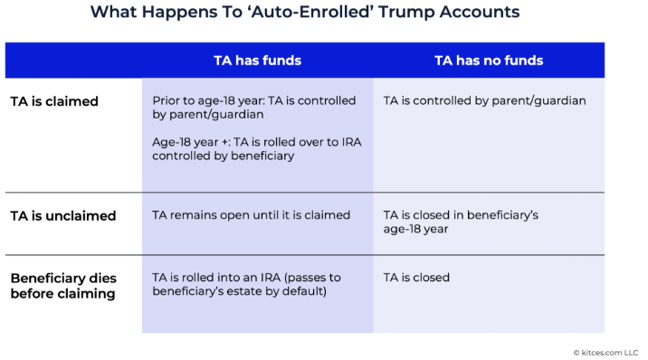
• Orphaned and forgotten. Small accounts are the ones that get lost. Untangling an orphaned account years from now is far more work than claiming it today. As of today, there are a couple of potential outcomes as summarized in this chart:
• A surprise at 18. The account belongs to your child. When they reach adulthood, they may discover an account they’ve never heard of, under rules no one ever explained to them. That is not the financial introduction most parents have in mind.
What to do now
Claim an account for every child under 18 in your household, even if you have no intention of funding it. Confirm the details are correct, note which institution holds it, set up online access, and file the information with the rest of your financial records.
And expect scammers to piggyback on this announcement. Only claim accounts through official trumpaccount.gov or trumpaccount.com websites (or the mobile app), never click links in unsolicited texts or emails about “activating” your child’s account, and don’t share Social Security numbers or banking information with anyone you haven’t independently verified.
This process involves the following:
• Data input: Name, DOB, address, SSN, etc
• ID Verification: taking a picture of your ID (passport/driver’s license/etc.) as well as your face (I had to do this process twice, once at the beginning and once at the end).
• Child’s info: Name, DOB, SSN and an affidavit stating that you are the legal guardian of the child eligible to claim the account on their behalf
• Submit all information and wait for a confirmation (which the website says can take up to 3 days)
Claiming an account doesn’t commit you to funding it. Whether a Trump Account deserves a place in your plan alongside 529s, custodial accounts, UTMAs, trusts and other tools is a separate conversation, and one worth having with your advisory team. But taking control of an account that already exists in your child’s name is simply good risk management. It takes a few minutes, and there’s no good reason to wait. If you’d like help, give us a call.
The opinions voiced in this material are for general information only and are not intended to provide specific advice or recommendations for any individual. There is no assurance that the views or strategies discussed are suitable for all investors or will yield positive outcomes. Investing involves risks including possible loss of principal. No investment strategy can guarantee a return or eliminate risk.
Trump Accounts are subject to rules and guidance issued by the U.S. Treasury Department and the Internal Revenue Service, which may change. This material is not intended as tax or legal advice. Please consult your tax advisor regarding your specific situation.
Investment advice offered through Great Valley Advisor Group, a Registered Investment Advisor. Great Valley Advisor Group and Nexa Financial Group are separate entities.