By: Nexa Financial Group
“Long may you run, long may you run, Although these changes have come, With your chrome heart shining in the sun, Long may you run”
–Long May You Run, Neil Young, 1976
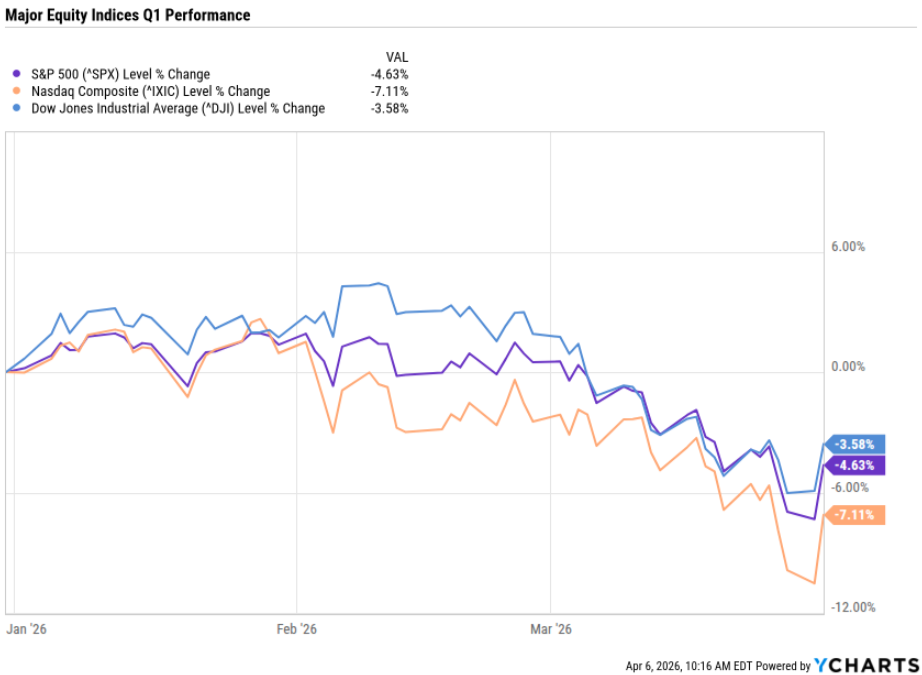
What a difference a month makes. It was at this same time thirty days ago when the S&P 500 was embroiled in an eight week decline that had it on the brink of falling into correction territory down more than -10% from late January highs. Fast forward just three weeks later, and this same S&P 500 blasted to new all-time highs following a furious +13% rally. What has been arguably even more impressive is what has happened in the trading days since. Regardless of what continues to unfold in Iran or anywhere else in the world for that matter, this is a market that has all the looks of wanting to go higher through the spring and into the summer. We have potentially entered the “Go Like Hell” phase of the S&P 500 at 7000+.

Chrome heart shining in the sun. In a theme that has run as long as Young’s 1948 Buick Roadmaster hearse (17 years and counting), “buy the dip” continues to reward investors in the post Great Financial Crisis period. Time and time again we have seen the S&P 500 enter into pullbacks (down less than -10%), corrections (down more than -10%), and even fleeting bear markets (down more than -20%) over periods typically lasting anywhere between four to twelve weeks, and US stocks find a bottom followed by a subsequent slingshot to new all-time highs. Arguably the biggest risk in the post financial crisis period has not been being allocated to downside risk, but instead has been not being allocated to upside risk. As the chart below shows once again, miss 13 trading days from March 31 to April 16, miss a lot.
But what is even more impressive than the latest slingshot rally is how the market has performed since breaking out to new all-time highs. In the process of the rally, the S&P 500 also broke decisively above upward sloping trendline resistance (straight blue line on chart) that has been in place since Halloween. One would reasonably expect from a technical perspective that a stock market that has rallied by more than +10% over a two week period to surge from oversold (Relative Strength Index (RSI) below 30, due for a bounce) to overbought (RSI above 70, due for a pullback) would find it’s way back to the downside for a spell as traders take some money off the table (those that may have wanted to sell at 7000 in late January getting a fresh chance to get out of the market). Instead, the S&P 500 has held it’s ground and if anything has continued to grind to the upside for nine trading days and counting. This is a market that is refueling and reloading on the run. In short, this is a market that wants to continue going higher.
The obvious next question – are recent gains and the determination by stocks to continue higher justified? The answer is yes from a fundamental standpoint. As frequently stated in these pages, current and forecasted economic growth remains positive, inflation expectations remain in check, and the corporate earnings outlook is still phenomenal with high teens profit growth on the S&P 500 projected through next year.
What about stock valuations? Yes, the trailing 12-month P/E ratio on the S&P 500 at just over 28x is well over the 5-year and 10-year historical averages in the 24x neighborhood based on FactSet data (enjoy your retirement S&P Global’s Howard Silverblatt – it was great using your publicly available S&P data for the last 25 years). And yes, the forward 12-month P/E at 21x is also higher, albeit less so, than the 5-year average at 20x and 10-year average at just below 19x. But we are far from extreme valuations in the current market environment, and history has shown us that premium stock valuations typically do not matter until they matter a lot. When does this happen? When the economy falls into recession (see above). All good here for now.
Putting this all together, these are good times once again for the US stock market. But capital markets are not without risks. Thus, it is worthwhile to dig deeper under the surface to identify what we should be watching as school years come to an end and the summer vacation season begins.
Long may you run. The headline market cap S&P 500 Index continues to be a stellar performer, but how broad based is this latest rally. For the answer, let’s look at the equal weighted S&P 500 that looks past the fact that just 9 stocks out of 503 (1.8% of all stocks in the index) make up 40% of the total weight and instead weights every stock evenly at roughly 0.2% each.
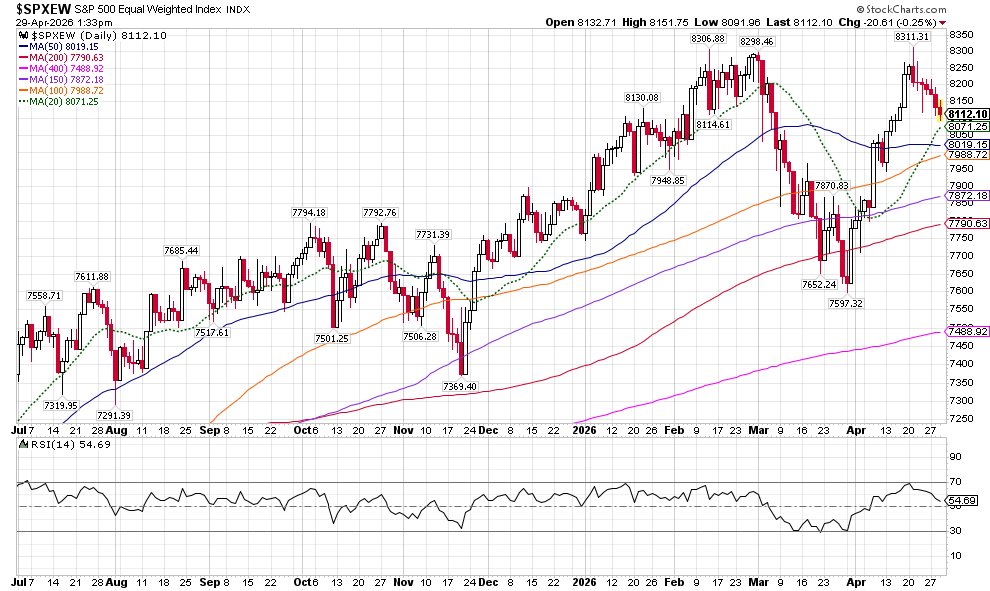
Now this is more what we would expect to see. Stocks rallied to new all-time highs through April 17, but then the traders who wished they had sold back at the end of February descended. We’ve given back -2.5% on an equal weighted basis in the trading days since. Notable, but not necessarily a problem. In fact, it’s reassuring, as you want a market that is behaving normally over time. This includes the symmetry of the correction and the subsequent rally (almost a perfect V) and the give back from the previous high. With all of this being said, we need to watch the various moving average support levels in the coming weeks for confirmation that the ongoing uptrend remains intact. Moreover, the 7600 level on the index should also remain on the radar screen. While a lot of downside work would be required, a definitive breach of this neckline level would potentially complete a bearish double-top technical formation. A long way to go on this one, but worth mentioning.
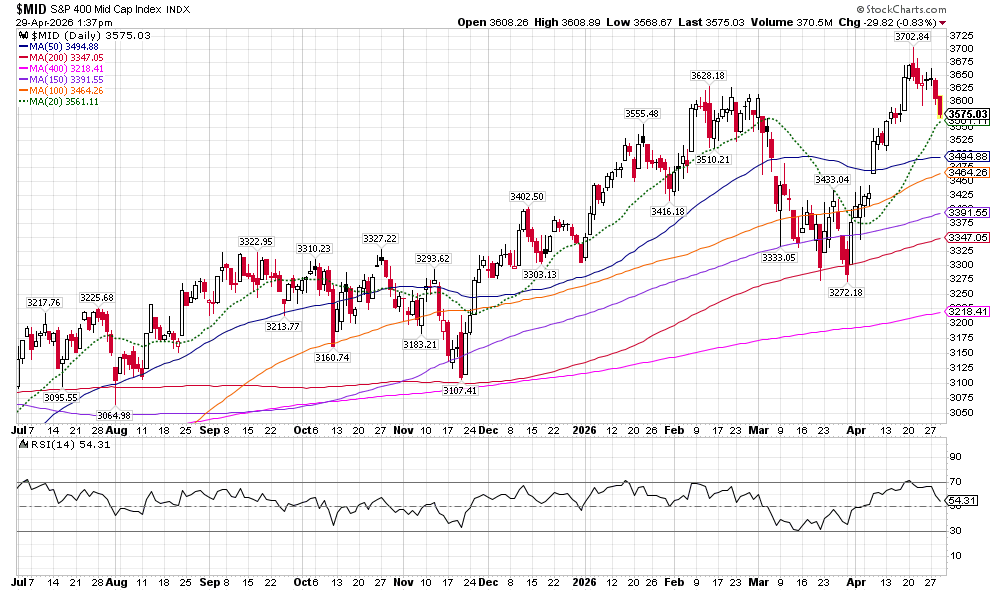
On a reassuring note, it’s worth mentioning that the mid-cap S&P 400 Index, which is highly correlated with the equal weighted S&P 500 Index, did manage to set new highs and is showing more sustained upside strength. Nonetheless, 3560 on this index will be worth watching in the coming days for a potential bounce.
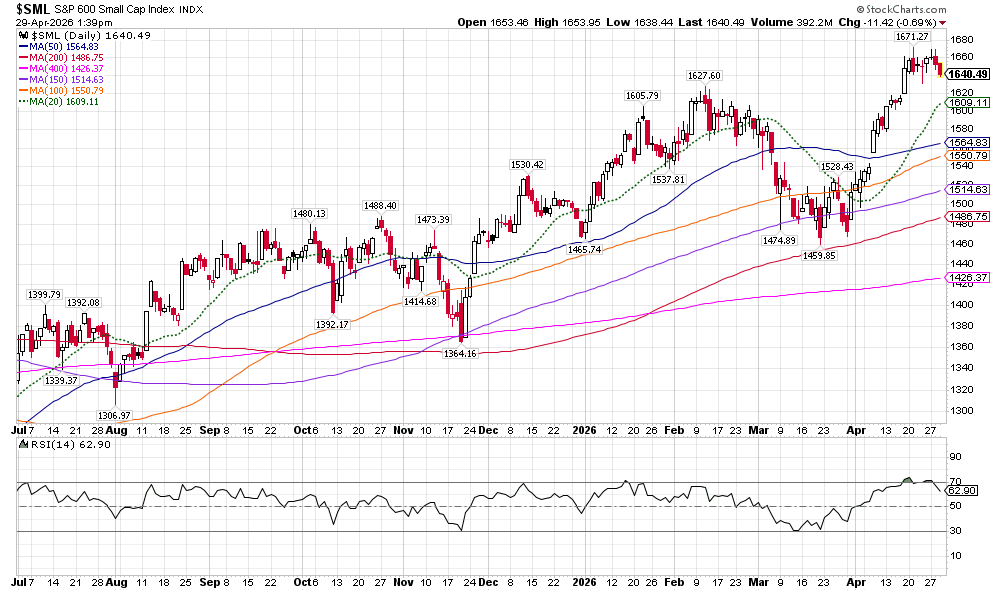
As for small caps, arguably the most supportive underneath the headline surface, for despite all of their relative struggles since the GFC, they are looking most market cap weighted S&P 500ish in the current episode.
Let’s look beyond stocks to additional signals to watch.
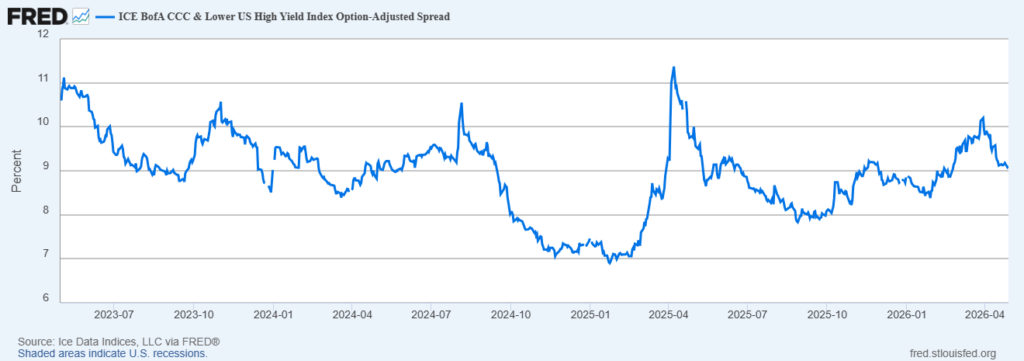
On the bullish side are CCC & Lower US High Yield spreads, which historically have been a leading risk indicator for broader markets. This was a point of concern a few weeks ago, as steadily rising spreads had crested back above 10% for the only the fourth time since the inflation outbreak of 2022 (the additional yield premium investors were requiring to take on the risk of owning the lowest quality bonds in the high yield universe – wider spreads, greater investor risk aversion and vice versa). But no sooner did the calendar flip to April and spreads collapsed back toward 9% and to average post 2022 levels.
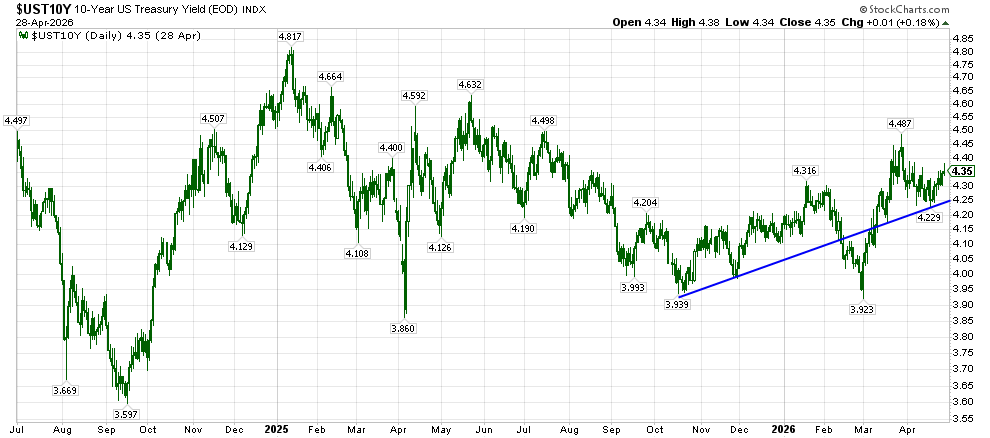
On the flip side, a few arguably more bearish readings merit monitoring. One is U.S. Treasury yields, which have turned back higher recently and have been steadily on the rise dating back to last October. While they remain well below recent January 2025 peaks, a continued rise in yields will put increasing pressure on stock valuations.
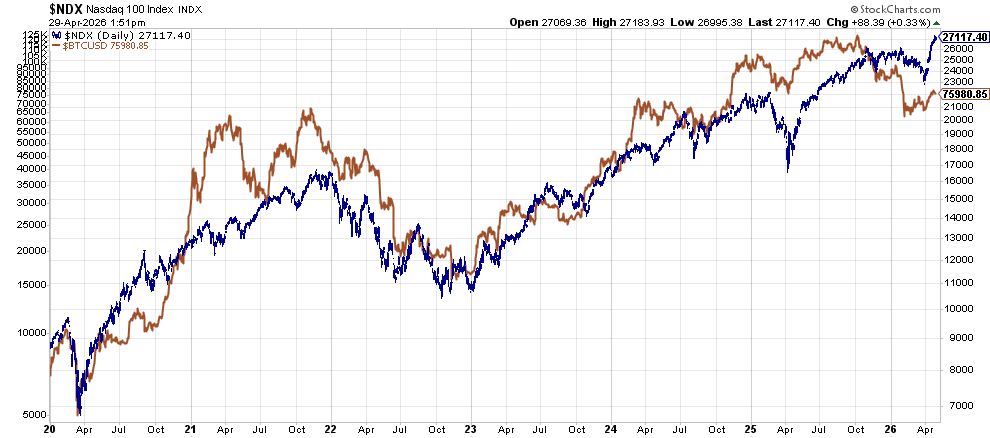
Another is the ongoing relationship between the NASDAQ 100 where many of the leading tech and tech related stocks reside and cryptocurrencies, which if nothing else are a reading of speculative appetite among investors. These two readings have diverged for short-term periods of time over the last decade before eventually reconverging. What is notable of late is that the cryptocurrency implied price for the NASDAQ 100 is now meaningfully lower from current levels. Thus, we will want to watch to see if cryptocurrencies catch a bid to the upside to help resolve this gap instead.
Bottom line. The U.S. stock market is back going like hell to the upside. And underlying fundamentals support the move. But the markets are not without risks. Continue to remain dedicated with your long-term investment plan, but also continue to monitor for downside risks and make adjustments on the margins accordingly as needed in case the markets start rolling down an empty ocean road instead.
Disclosure: I/we have no stock, option or similar derivative position in any of the companies mentioned, and no plans to initiate any such positions within the next 72 hours. I wrote this article myself, and it expresses my own opinions. I am not receiving compensation for it. I have no business relationship with any company whose stock is mentioned in this article.
Investment advice offered through Great Valley Advisor Group (GVA), a Registered Investment Advisor. I am solely an investment advisor representative of Great Valley Advisor Group, and not affiliated with LPL Financial. Any opinions or views expressed by me are not those of LPL Financial. This is not intended to be used as tax or legal advice. All performance referenced is historical and is no guarantee of future results. All indices are unmanaged and may not be invested into directly. Please consult a tax or legal professional for specific information and advice. LPL Compliance Tracking #1101071.