By: Paul Morrone
We’re fresh off another great year for equities, and 2026 is now underway. The year started with a bang with some big geopolitical (capture of Venezuelan President Maduro) and financial headlines (DOJ investigation into Fed Chair Jay Powell), which markets have largely shrugged off. What’s to come in the coming months is anyone’s guess, however, we dove into the data to discuss some potential outcomes through the rest of the year. We were joined by Eric Parnell, CFA, Chief Market Strategist – Great Valley Advisor Group to recap some of the themes from 2025 and discuss our outlook, risks and opportunities on the horizon in 2026. While we encourage you to watch the replay of the event, we understand committing an hour or more of your time is a big ask. Below is a summary of key points from the event to help catch you up to speed.
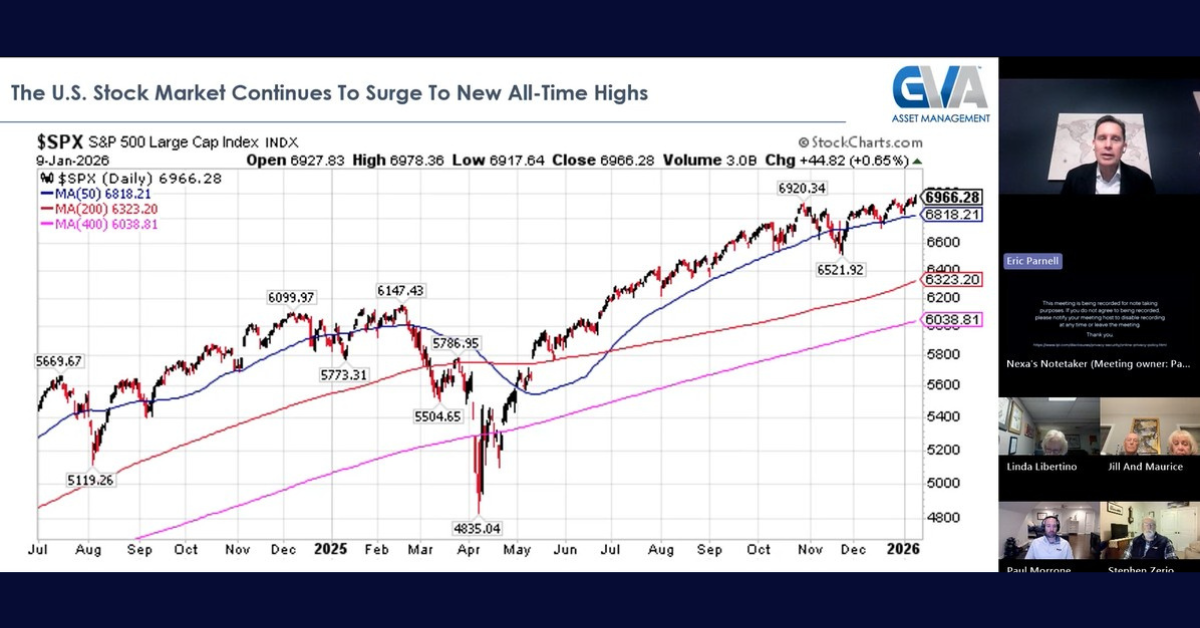
- U.S. Equity Performance and S&P 500 Hitting 7,000: Eric highlighted that the S&P 500 index, which was below 4,000 just three years prior, recently approached (but hasn’t yet hit) 7,000. He recalled the October 2025 level at about 6,920, where it peaked before the 4Q selloff down to 6,521, which has been followed by a steady climb back to today’s values of roughly 6,960. Despite common beliefs that the market might be “due” for a pullback, Eric emphasized that as long as fundamentals (particularly corporate earnings growth) remain solid, equities can continue rising.
- Market Corrections and Tech Leadership: Eric discussed the notable April 2025 correction, where the S&P 500 declined roughly 21% from mid-February to mid-April, largely attributed to tariff and inflation concerns. He explained that such corrections are an indication of a healthy market and can help cleanse market excesses. The conversation also addressed the concentrated performance by U.S. technology and communication services in recent years, underscoring just a select group of stocks—the so-called “MAG 7”—driving the S&P 500. Paul and Eric noted that the market began to broaden out in late 2025, with nearly 60% of S&P 500 components outperforming the index early coming into 2026.
- Economic Growth and Corporate Earnings: Eric referenced the Federal Reserve Bank of New York’s “Nowcast,” projecting over 2.5% GDP growth in the first quarter of 2026. Coupled with corporate profit forecasts for the S&P 500 that show continued projected double-digit growth through the end of 2026, the outlook for U.S. equities remains favorable. He suggested base-case expectations for the S&P 500 in 2026 might be mid- to high-single to low-double-digit percentage returns if companies deliver on their earnings guidance.
- Bond Market Environment and Inflation Risks: Eric noted that from 1981 to about 2021, falling yields benefited bondholders while also providing a straightforward diversification tool. Beginning in 2022, yields moved notably higher, much in response to the Fed’s tightening campaign to fight the growing inflation problem, with a spike in the 10-year treasury yield from a rock bottom 0.5% to nearly 5% by October 2023. Since then, the 10-year has dropped some, but remains range-bound in the 3.5%-4.5% range. Eric explained the diversification role of shortened-duration bonds and how higher coupons today can help generate steady income while liming price volatility.
- Risks to Both Stock and Bond Markets in 2026: They identified inflation’s resurgence as the number-one risk to watch heading into 2026, emphasizing that if inflation expectations rise quickly above the current ~2.3% for the five-year break-even rate, it could disrupt equity and bond markets.
- Diversification Beyond Stocks and Bonds: Paul and Eric stressed that in addition to equities and bonds, alternative assets remain crucial. Gold was highlighted for its strong performance in 2024 and 2025 – gaining over 60% – and the compared the performance to other assets such as equities and bonds over the past several years to show how differing exposures can move independently of one-another and can provide risk management within a portfolio and potentially drive higher returns over the long-term. They underscored a broader approach to “equity vs. non-equity” allocations rather than a limited “stock vs. bond” mindset created by the traditional 60/40 portfolio.
- International Equity Markets and the Impact of a Weaker U.S. Dollar: Eric pointed out that over the last ~15-year period, U.S. equities vastly outperformed developed international and emerging markets. However, in 2025, developed international and emerging stocks posted returns of roughly 36% and 42%, respectively, surpassing the S&P 500’s 19%. Eric attributed this recent weaking of the U.S. Dollar Index, which dropped from about 110 to 96 during 2025, creating a tailwind for international equities. He observed that fiscal and monetary policies in the United States may drive further currency weakness as this has been a priority of the Trump administration to make exports of U.S. goods and services cheaper for international companies to buy. With the index’s long-term average near 94, Eric forecasted that the dollar could trend lower still, which may provide further support for an outperformance in non-U.S. equities.
- Fed Chair Change and Midterm Elections: Eric explained that a new Federal Reserve Chair is expected on May 15, 2026, with the current frontrunner assumed to be someone with prior central banking experience, such as Kevin Warsh. We detailed why Fed independence matters and how political pressures to cut rates prematurely could reignite inflation and how this has failed in past instances when the Fed was politically pressured. With respect to midterm elections, we noted that while the outcome could influence regulatory, tax or fiscal policies, markets generally handle political changes well, with gridlock or one-party control both historically absorbed by the market after initial volatility.
The opinions voiced in this presentation are for general information only and are not intended to provide specific advice or recommendations for any individual. There is no assurance that the views or strategies discussed are suitable for all investors or will yield positive outcomes. To determine which investment(s) may be appropriate for you, please consult your financial professional prior to investing. Investing involves risks including possible loss of principal. No investment strategy or risk management technique can guarantee return or eliminate risk. Any economic forecasts set forth may not develop as predicted and are subject to change. All indices are unmanaged and may not be invested into directly. Past performance is no guarantee of future results.
Eric Parnell is solely an investment advisor representative of Great Valley Advisor Group and is not affiliated with LPL Financial. Any opinions or views expressed by Eric are his own and are not those of LPL Financial.
Securities offered through LPL Financial – Member FINRA/SIPC.
Advisors associated with Nexa Financial Group may be either (1) LPL Financial Registered Representatives offering securities through LPL Financial, Member FINRA and SIPC, and investment advisor representatives offering investment advice through Great Valley Advisor Group; or (2) solely investment advisor representatives offering investment advice through Great Valley Advisor Group and not affiliated with LPL Financial. Great Valley Advisor Group, and Nexa Financial Group are separate entities.