
By: Nexa Financial Group
The AI boom’s biggest supply constraint right now isn’t GPUs. It’s memory. Every AI server in every data center powering tools like ChatGPT and Claude is only as fast as the memory chip sitting next to its processor. That memory is now in short supply. Prices for the two main types, DRAM and NAND flash, jumped 58 to 63% and 70 to 75%, respectively, in the second quarter of 2026 alone, the sharpest increases the industry has seen in over a decade. This is not a typical cyclical shortage. It is a structural reallocation of global manufacturing capacity toward artificial intelligence, and it is becoming one of the clearest bottlenecks in the AI buildout.
Memory 101
Memory chips serve two different jobs inside any computer, whether it’s a smartphone or a server rack, the tall metal frame of stacked computers that data centers use to run everything from websites to AI models. DRAM is the working memory a processor uses to hold data it’s actively crunching. It’s fast but temporary, wiped clean when the device powers off. NAND flash is storage, where data sits permanently, the chips inside a laptop’s SSD or a phone’s internal storage. Every device with a processor needs both.
HBM, or high bandwidth memory, is a specialized and far more expensive category of DRAM built for one purpose: feeding data to AI chips fast enough to keep them working. AI chips, most commonly Nvidia’s GPUs, are specialized processors built to run the enormous number of calculations behind training and operating AI models like ChatGPT, Claude, and Gemini. These tasks involve constantly moving huge volumes of data rather than the more modest data needs of a typical laptop chip. Instead of sitting on a separate module across the motherboard, HBM is built by stacking multiple DRAM layers directly on top of one another and wiring them together so data can move in and out at extraordinary speed, then placing that stack within a hair’s width of the processor itself. If that’s a lot to take in, here’s the simpler version. Think of an AI chip as a race car engine. Raw horsepower means nothing if the fuel line feeding the engine is too narrow. HBM is the wide fuel line that lets a chip like Nvidia’s GPU actually use the processing power it has.
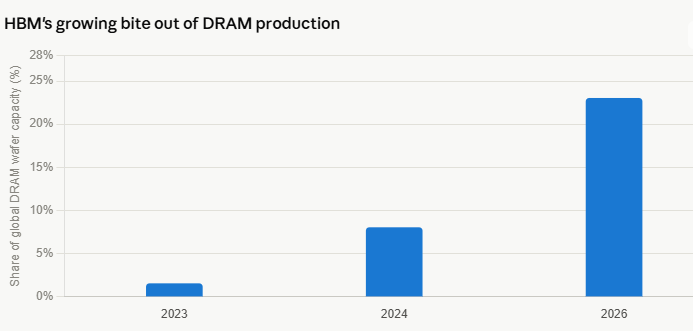
This is precisely why memory has become an AI bottleneck in its own right. A single AI server can require eight to ten times the DRAM of a traditional server, and manufacturing HBM consumes three to five times the wafer capacity of standard DRAM for the same output. Building more AI compute capacity does not just require more chips. It requires an outsized amount of a specialized memory type that is difficult and expensive to produce at scale.
Why This Cycle Is Different
Memory has always been a boom and bust business. Shortages in 2017 and 2018 and again in 2021 pushed prices sharply higher, then resolved as manufacturers ramped up production to meet demand, the normal rhythm of a cyclical industry. This time is different. Samsung, SK Hynix, and Micron, the three companies that together control 95% of global DRAM production, have deliberately shifted manufacturing capacity away from standard memory chips and toward HBM. This is because HBM commands far higher profit margins. That reallocation does not reverse just because prices for standard DRAM and NAND rise. Manufacturers have little incentive to redirect capacity back to lower margin products while AI demand for HBM remains this strong. The usual price signal that resolves a shortage, higher prices attracting more supply, isn’t working the way it normally would.
When Does This Actually End
New capacity is coming, just not soon. SK Hynix’s M15X fab in Cheongju, South Korea began ramping production in 2026. Micron’s Idaho fab is targeted to come online in 2027. Samsung’s P5 fab in Pyeongtaek is aiming for volume production in the second half of 2028, and Micron’s planned New York fab isn’t expected until 2029 or 2030. Even once these facilities are running, priority goes to HBM and other high margin products first, which means relief for standard DRAM and NAND, the memory in ordinary laptops and phones, lags further behind. Based on this, the realistic window for meaningful supply relief is 2027 at the earliest, with a return to something resembling normal pricing more likely in 2028 or later, assuming AI demand growth doesn’t accelerate further and push that timeline out again.
Winners and Losers
The reallocation of memory capacity toward AI is creating a clear divide across the tech sector. On one side, the memory manufacturers themselves, Samsung, SK Hynix, and Micron, are seeing sharply higher margins as prices for their highest value products surge. Equipment makers that supply the tools needed to build HBM, along with companies that handle the complex packaging and testing steps HBM requires, are benefiting, as well. TSMC, for example, runs its own advanced packaging process that physically bonds memory to AI chips like Nvidia’s, and demand for that service now outpaces what even TSMC alone can supply.
On the other side, companies that depend on standard DRAM and NAND without long term supply agreements are facing rising costs and tighter availability. Elon Musk described Tesla’s predicament in stark terms in January, framing it as a choice between hitting a “chip wall” or building its own fab, a sign that even a company with Tesla’s resources is running into allocation limits. Apple, by contrast, has struck a more measured tone with investors, describing only a modest impact so far though it has signaled the shortage could affect production more broadly as the year continues. For consumer electronics makers generally, memory now represents a rising share of total cost of building a phone or laptop, a cost that ultimately gets passed to buyers.
The Investment Angle
Memory has become of the clearer ways to think about AI infrastructure demand beyond the mega cap compute names most investors already know. Companies tied to advanced chip packaging, the step that physically bonds memory to AI processors, sit at a key pinch point in the buildout.
That said, this theme is worth approaching with some caution rather than chasing. Memory stocks have already rallied sharply as this shortage has played out, and a meaningful amount of the good news, including higher prices and sold-out capacity through the end of 2026, appears to be priced in. The more durable way to participate in the AI buildout theme is likely through businesses broad enough to benefit across multiple fronts, rather than a concentrated bet on memory pricing holding at today’s elevated levels indefinitely.
The Bigger Picture Memory has spent most of the AI era as a footnote to the story, overshadowed by GPUs, data centers, and the enormous sums hyperscalers pour into compute. That’s changing. The same dynamics reshaping the chip industry, surging demand colliding with a supply chain that can’t pivot quickly, are now playing out in a corner of the market most investors have never had reason to watch closely. Whether the memory shortage eases as new capacity comes online in 2027 and beyond, or persists longer as AI demand keeps outrunning supply, it’s now one of the clearest signals of how much the physical infrastructure underneath the artificial intelligence still has to catch up to the ambitions being built on top of it.
Disclosure: I/we have no stock, option or similar derivative position in any of the companies mentioned, and no plans to initiate any such positions within the next 72 hours. I wrote this article myself, and it expresses my own opinions. I am not receiving compensation for it. I have no business relationship with any company whose stock is mentioned in this article.
Investment advice offered through Great Valley Advisor Group (GVA), a Registered Investment Advisor. I am solely an investment advisor representative of Great Valley Advisor Group, and not affiliated with LPL Financial. Any opinions or views expressed by me are not those of LPL Financial. This is not intended to be used as tax or legal advice. All performance referenced is historical and is no guarantee of future results. All indices are unmanaged and may not be invested into directly. Please consult a tax or legal professional for specific information and advice. LPL Compliance Tracking #1119679.