By: Paul Morrone
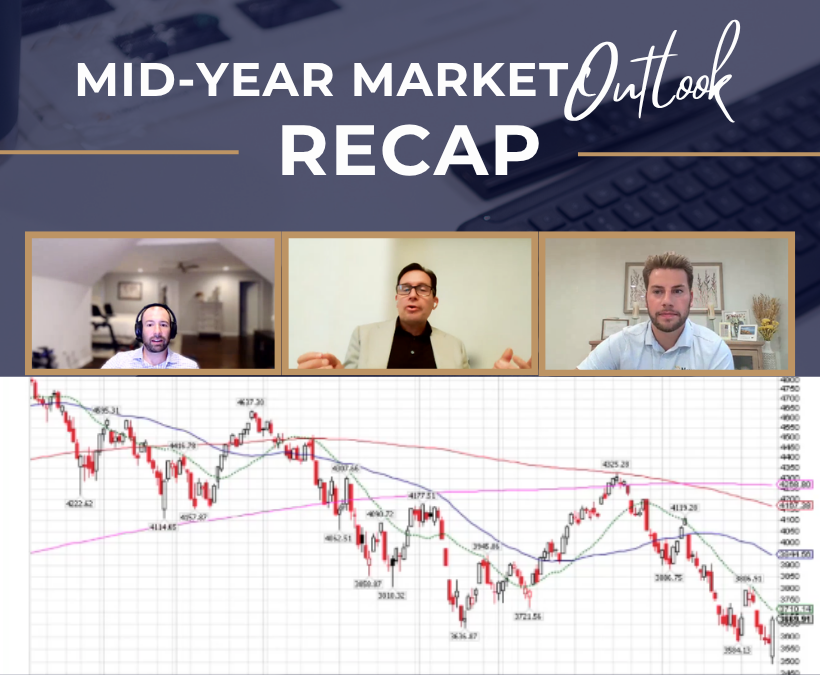
We welcomed a familiar face back to our screens this past week as we hosted our semi-annual market check-in webinar, featuring Eric Parnell, Chief Market Strategist at Great Valley Advisor Group. Our call covered the forces driving the U.S. stock market to new all-time highs despite a volatile geopolitical and economic backdrop, the broadening of market leadership beyond technology, shifts in fixed income positioning, and the key risks and long-term themes investors should watch heading into 2027.
Market Resilience Amid Uncertainty
Eric opened by acknowledging the steady stream of headline risks in 2026 — tariff uncertainty, elevated oil prices, and geopolitical conflict in Eastern Europe and the Middle East — yet emphasized that markets have continued to “climb a wall of worry” and push toward record highs. The S&P 500 began 2026 on a weak footing, falling roughly 10% from its January highs amid the onset of the Iran conflict in late February. Once markets grew comfortable with that uncertainty, a strong April and May rally erased the decline and pushed the index to fresh all-time highs.
Eric drew a historical parallel to past geopolitical shocks — including Pearl Harbor and 9/11 — noting that markets typically experience only a short-term disruption (days to months – not years) before resuming their prior trend. He cautioned that stepping to the sidelines during a crisis is risky, since recoveries tend to be “fast and furious”: the 2026 pullback in the wake of the warn in Iran, for example, took two months to unfold but only 12 trading days to fully reverse.
Despite the new highs, Eric noted the summer trading has been mostly a sideways, consolidating market — with virtually all gains concentrated in a handful of trading days in late July and early August. Using a long-term trend line, he characterized recent pullbacks as healthy consolidation rather than a warning sign, suggesting the S&P 500 could retest the 7,500 level without breaking the broader uptrend.
Three Fundamentals Supporting the Market
Eric outlined three fundamental, trackable indicators that continue to justify current valuations:
- Economic growth: The Atlanta Fed’s GDPNow estimate points to roughly 4% growth for Q3 2026 — well above the ~2% consensus — supporting corporate earnings and, in turn, stock prices.
- Inflation expectations: The five-year breakeven inflation rate (from the St. Louis Fed/FRED database) sits near five-year lows, signaling that markets expect inflation to remain under control despite higher energy prices — a sharp contrast to the 2022 inflation spike that drove a 20%+ market decline.
- Corporate profit growth: Earnings have grown more than 20% over the last three quarters, a pace Eric called “phenomenal.” Rising earnings (the “E” in the P/E ratio) help justify elevated valuations by lowering effective P/E multiples even as prices rise.
We related this to many of the high-multiple, headline-driving stocks (e.g., Palantir, Micron, Nvidia), noting that strong earnings don’t guarantee future gains if they fail to clear elevated and likely unrealistic expectations — Palantir fell roughly 45% despite handily beating estimates and providing stellar forward guidance. We also emphasized that client portfolios are diversified rather than concentrated in any single theme, limiting the impact of any one stock or sector’s swings.
A Broadening, More Diversified Rally
A central theme of the discussion was that technology and “Magnificent Seven” stocks have not been the primary drivers of 2026 gains. Since Halloween 2025, the S&P 500 is up over 11%, but growth stocks are roughly flat and the Magnificent Seven are down about 2% over the same period. Instead, leadership has come from recently overlooked sectors and asset classes:
- Energy: up sharply and at all-time highs, aided by the Iran conflict and rising oil prices.
- Industrials and materials: benefiting from a strong industrial economy, with returns nearing 20%.
- Healthcare: up 20% since late April after several weak years, on improving forward growth expectations.
- Value stocks: up roughly 27.5% since Halloween, far outpacing flat growth-stock performance.
- Small-cap, mid-cap, and international/emerging-market stocks: all outperforming the S&P 500, with international markets extending strong 2025 results.
We note that this broadening as healthy and consistent with our diversified, style-neutral approach — remaining invested in technology given its long-term growth story while maintaining exposure to value, small/mid-cap, and international holdings that can pick up leadership when growth stocks pause to “catch their breath.”
Fixed Income: Managing Duration in a Volatile Rate Environment
Turning to bonds, Eric identified renewed inflation and a related rise in Treasury yields as the second key risk to watch. The 10-year Treasury yield has risen substantially since 2020, and long-duration bonds have fallen roughly 10% in price since last October. However, from a return standpoint, we noted this doesn’t equate exactly to a 10% loss for investors, since income (coupon yield) offsets price declines and helps to lessen the blow for fixed income returns in times of volatility. From a portfolio positioning standpoint, we have held little to no long-duration debt for over a year now and have limited duration risk in client portfolios.
Eric explained that in today’s rising- and volatile-rate environment, short-duration bonds are preferable to long-duration holdings, since they currently capture attractive yields (4–5%) with far less price volatility. This reflects a deliberate shift in our strategies the past two years — favoring shorter duration to “let the coupon drive total return” rather than betting on interest-rate direction.
Key Risks and Themes to Watch
- Renewed inflation: Still cited as the number-one downside risk to markets, as it would force the Federal Reserve to raise rates more aggressively, as it did in 2022.
- The AI “arms race” and free cash flow: Mega-cap tech companies are shifting from strong free-cash-flow generators to heavy spenders (via debt and equity issuance) to compete in AI, which may bring more volatility and less consistent outperformance from former market leaders.
- Interest rates: Two Fed rate hikes are expected between now and next October, potentially starting as soon as September; markets should tolerate this if it’s viewed as inflation control rather than a reactive scramble.
- Real assets and onshoring: Commodities, infrastructure, and precious metals are expected to remain a long-term area of opportunity as deglobalization and reshoring accelerate.
Closing Takeaways
We closed by reiterating that current market strength rests on solid fundamentals — strong GDP growth, contained inflation expectations, and robust corporate profit growth — while acknowledging that a broadening, more diversified market, careful fixed-income duration management, and awareness of AI-related spending and rate risk will be key to navigating the remainder of 2026 and beyond. The next semi-annual outlook session is expected around the start of 2027.
The opinions voiced in this presentation are for general information only and are not intended to provide specific advice or recommendations for any individual. There is no assurance that the views or strategies discussed are suitable for all investors or will yield positive outcomes. To determine which investment(s) may be appropriate for you, please consult your financial professional prior to investing. Investing involves risks including possible loss of principal. . No investment strategy or risk management technique can guarantee return or eliminate risk. Any economic forecasts set forth may not develop as predicted and are subject to change. All indices are unmanaged and may not be invested into directly. Past performance is no guarantee of future results.
Eric Parnell is solely an investment advisor representative of Great Valley Advisor Group and is not affiliated with LPL Financial. Any opinions or views expressed by Eric are his own and are not those of LPL Financial.
Securities offered through LPL Financial – Member FINRA/SIPC.
Advisors associated with Nexa Financial Group may be either (1) LPL Financial Registered Representatives offering securities through LPL Financial, Member FINRA and SIPC, and investment advisor representatives offering investment advice through Great Valley Advisor Group; or (2) solely investment advisor representatives offering investment advice through Great Valley Advisor Group and not affiliated with LPL Financial. Great Valley Advisor Group, and Nexa Financial Group are separate entities.
Tracking: 1166164