By: Nexa Financial Group
“I know times are changing, It’s time we reach out for something new, That means you, too, You say you want to be a leader, But you say you can’t seem to make up your mind, I think you better close it, And let me guide you to the purple rain” – Purple Rain, Prince and the Revolution, 1984
The U.S. stock market remains on fire. After what had been a middling summer so far throughout June and July has whipped up into a new inferno as August gets underway. Over the last seven trading days, not only has the S&P 500 surged by as much as +6.6%, but it has broken out above previous resistance at 7620 to new all-time highs. Fundamental justification? Atlanta Fed GDP Now forecasting 5.9% growth for 2026Q3, 5-year breakeven inflation rate at 2.2%, and corporate earnings growing at a +20% annualized rate – check, check, and CHECK. Even market breadth has been improving with more and more stock market sectors getting in on the action. Both technology and energy are market leaders (!?!) – it’s like cats and dogs playing together. What could possibly go wrong to bring us to the end of these glorious market days?
Here are three things that are worrying me as we move through the remainder of the summer.
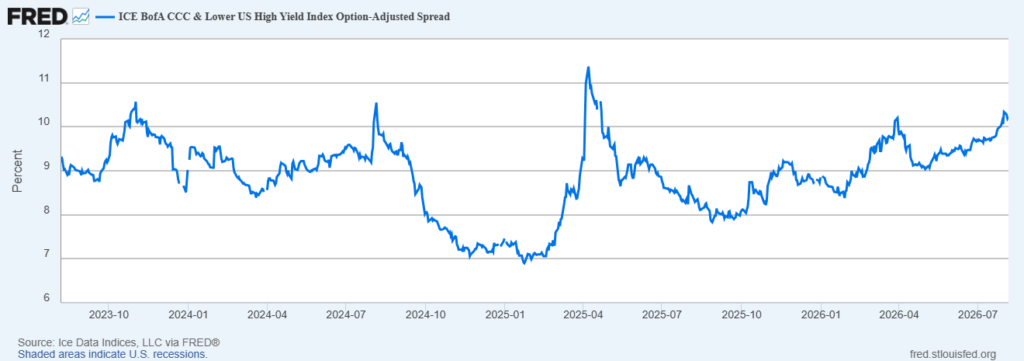
First, investors are showing a steadily creeping degree of increased risk aversion. Consider CCC and lower high yield spreads, which is a mouthful way of describing how much extra yield investors require to own the lowest quality bonds with the highest risk of default in the marketplace. Why does this metric matter? Because if investors are increasingly worried about losing their money in the market and thus pulling their money out of the market), the first place we typically see this happening is with the securities that offer the greatest risk of losing your money. Looking at the image below and taking out the tariff induced blip from spring of last year, we see that the yield investors have required to own these securities has been steadily rising from a low around 7% back at the start of 2025 to over 10% today. Not necessarily “book of revelations” type stuff, but something worth keeping an eye on in the market skies as we continue into the fall.
It should also be noted that the chasm between the price of cryptocurrencies (down -50% or more on average since last October) and the NASDAQ 100 (up +30% over this same time period) is becoming increasingly wide and worrisome. Maybe the relationship dating back more than a decade has finally broken down. Or maybe cryptocurrencies have a furious rally ahead to catch up to the upside. But then again . . .
Second is the volatility that is building underneath the market surface. Let’s consider the CBOE Volatility Index, or the VIX, which is a measure of investor fear expressed by how much they are willing to pay for options contracts on the S&P 500 Index (often, they are buying these options contracts for protection/insurance against a market decline). With a VIX at 15.40 that is as low as it’s generally been in recent years, all is calm, all is bright, am I right?
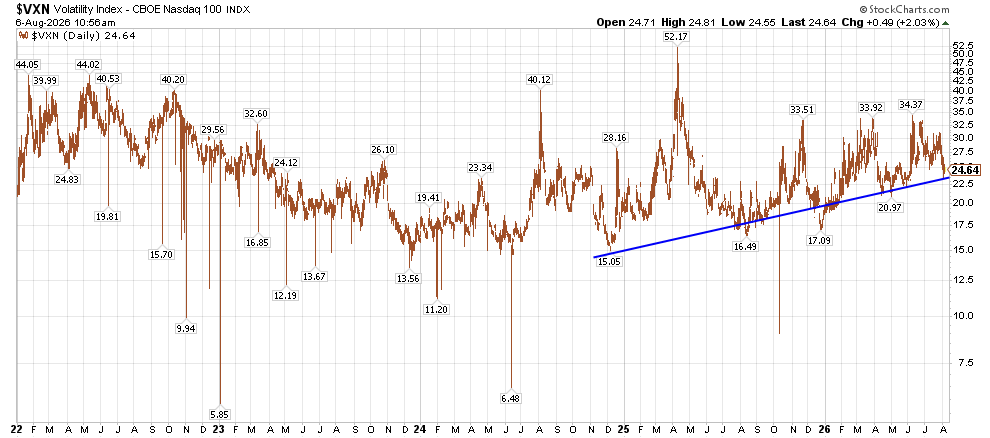
But let’s dig a little bit deeper and look at the volatility index instead of the NASDAQ 100, which is where many of the big tech AI names reside. Here we see volatility steadily on the rise once again since the beginning of 2025. Nothing cataclysmic to be sure, but certainly no longer the steady decline in fear of tech stocks we were seeing throughout 2023 and 2024.
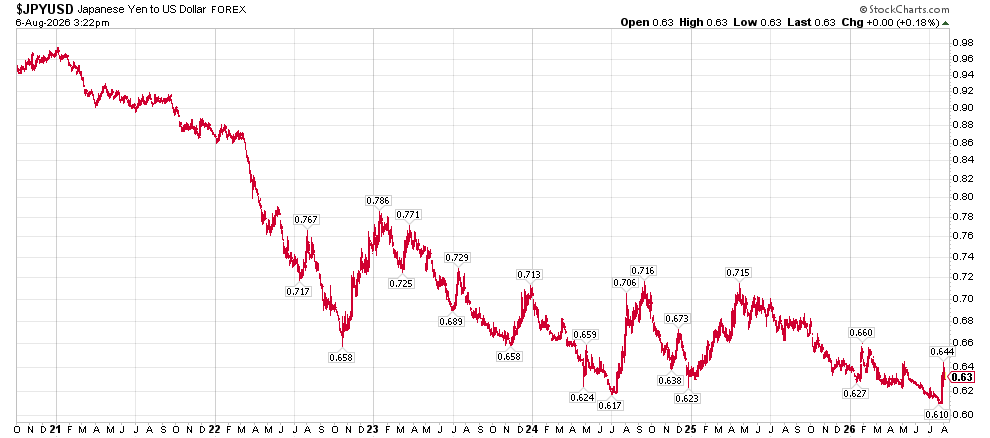
Third, in arguably the biggest current market event right now that nobody is talking about, the U.S. Treasury is busy working with the Bank of Japan to buy the yen currency to prevent it from collapsing further. Currencies Parnell!?! Zzzzzz… Stay with me. This matters because a disorderly unwind of the yen carry trade could lead to a crisis situation where Japan needs to dump US Treasuries, which would trigger a violent unwind of trillions in yen-funded trades across global markets. Um, what? One sentence primer on the yen carry trade – borrow yen cheaply at near 0% for decades until recently, convert to dollars, invest in growth assets like tech stocks and crypto among other things, pocket the spread between what you pay to borrow and what you earn – if the trade unwinds, gotta sell all the tech stocks and crypto that you bought along the way. Liquidity squeeze! (we saw a small taste of this almost exactly two years ago at the start of August 2024 – that’s the 65.73 on the red VIX chart above – markets were afeared for a few days back then my friends). Policy makers are taking a proactive approach here, so very possibly falling under the category of “nothing to see here, carry on”. But worth monitoring on page three to five of your virtual Wall Street Journal as events unfold nonetheless (who wants to read about currency intervention unless they have to when AI stocks are talking about cool stuff every day? I do, but that’s why I do what I do I suppose!).
Bottom line. US markets are on fire, but growing pockets of brimstone continue to form underneath the market surface. It all may amount to nothing – markets are continuously climbing a wall of worry as they always like to say – but these are the current worries worth keeping an eye on as we continue through the summer of 2026.
Eric Parnell, CFA | Chief Market Strategist
Eric Parnell is the Chief Market Strategist for Great Valley Advisor Group. Eric applies his expertise in finance and economics to manage multi-asset portfolios, mitigate risk, deliver advice that promotes informed decision-making, and facilitate investors achieving their short-and long-term investment goals. He leads the GVA Asset Management platform overseeing the management of asset allocation models for GVA advisors and their end clients. Eric also provides economic, market, and investment related analysis and communications to the GVA network of advisors and clients as well as the broader financial media. Eric has appeared on CNBC, CNN, Money Matters TV, NPR-Marketplace, Seeking Alpha, and CFA Magazine.
Eric has more than 25 years of financial and investment experience. Prior to joining GVA, Eric was the Founder and Director of Gerring Capital Partners, a Registered Investment Advisor serving clients nationwide. Eric also previously served as the Director of Investment Communications for SEI Investments and as an Economist at Moody’s Analytics. Eric is also an active member of the CFA Society of Philadelphia and the Global Interdependence Center.
Disclosure: I/we have no stock, option, or similar derivative position in any of the companies mentioned, and no plans to initiate any such positions within the next 72 hours. I wrote this article myself, and it expresses my own opinions. I am not receiving compensation for it. I have no business relationship with any company whose stock is mentioned in this article.
Investment advice offered through Great Valley Advisor Group (GVA), a Registered Investment Advisor. I am solely an investment advisor representative of Great Valley Advisor Group, and not affiliated with LPL Financial. Any opinions or views expressed by me are not those of LPL Financial. This is not intended to be used as tax or legal advice. All performance referenced is historical and is no guarantee of future results. All indices are unmanaged and may not be invested into directly. Please consult a tax or legal professional for specific information and advice. LPL Compliance Tracking #1156134
The economic forecasts set forth in this material may not develop as predicted and there can be no guarantee that strategies promoted will be successful. All investing involves risk including loss of principal. No strategy assures success or protects against loss.